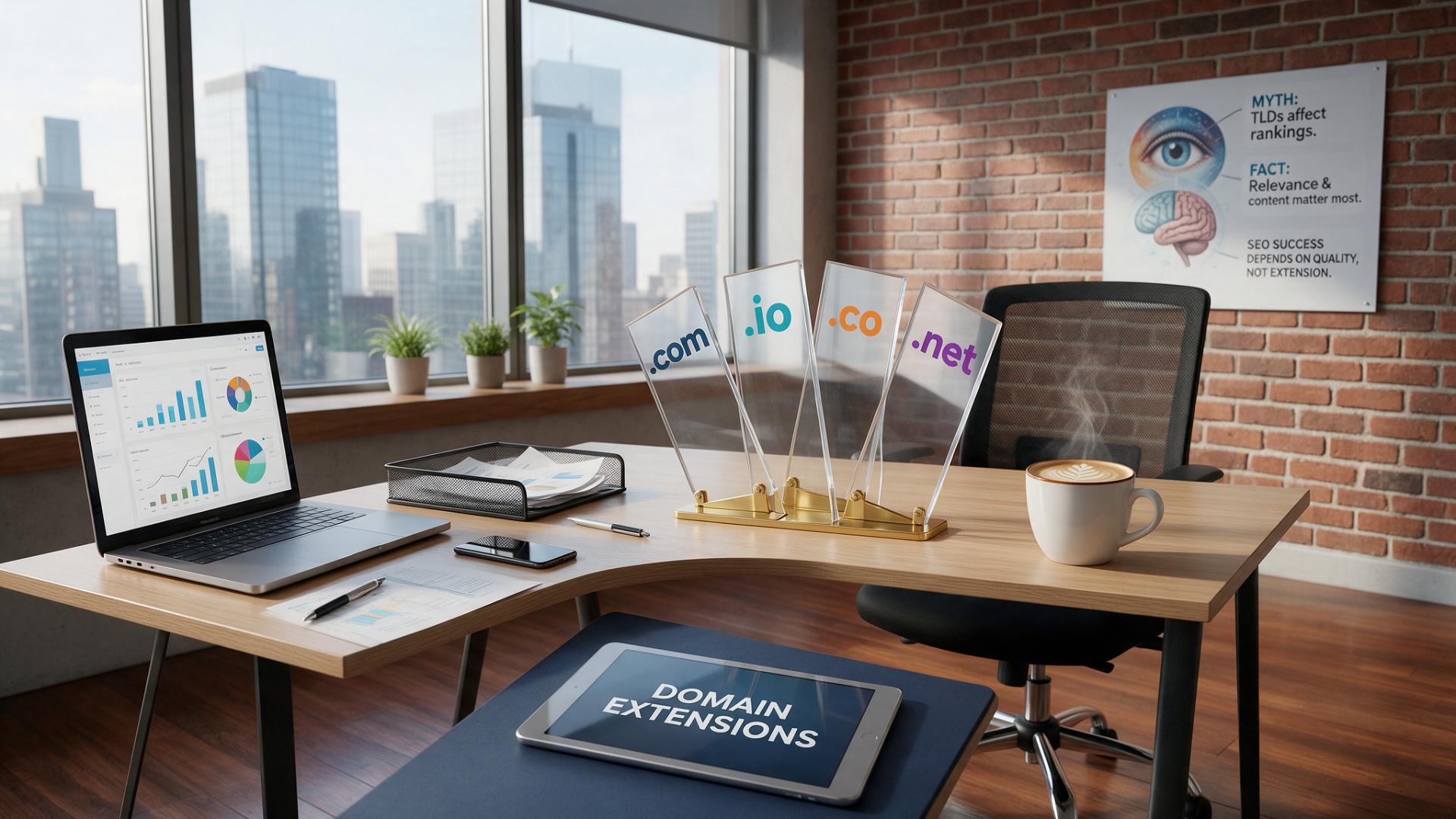
A landing page has one job and a short life, so the domain extension feels like a small decision that can be settled in a minute. Advice on the subject runs from the claim that only .com can rank to the claim that the extension does not matter at all, and both camps contain a grain of truth.
The top-level domain is the part after the final dot, and search engines read it as one signal among many. Nothing in the extension itself gives a page a ranking bonus, which is why a well built site on a less common ending can outrank a thin site on .com. The effects that do exist are indirect and run through people and through geography.
DotRoll's blog tackles the question under the plain title does a TLD affect SEO, and its answer is that the extension itself does not affect rankings but can influence user trust and click-through rates. Visitors tend to treat familiar endings as more credible, and a result that looks trustworthy earns more clicks, which can feed back into performance. The same article adds a technical point about country-code domains, which interact with geographic targeting settings in Google Search Console.
For a landing page that depends on paid or social traffic, the trust effect matters more than any ranking effect, because the visitor decides within seconds whether the address looks real.
Google's guidance on multi-regional and multilingual sites is the best primary source for the geographic part. It describes country-code top-level domains such as .de for Germany as a strong signal that a site is intended for a certain country, and notes that some countries restrict who can register them. It also says that server location, through the IP address of the host, is a signal but not a definitive one, because many sites use content delivery networks or host abroad.
The same page lists the domains Google treats as generic. Any ending that is not a country code is a gTLD, so the newer endings count as generic like .com and .org. Regional endings such as .eu and .asia are generic as well, and a list of country-code domains including .io, .ai, .co, .me and .tv is treated as generic because users and owners see them that way. A generic domain that wants to reach one country should set a country target through hreflang annotations or locale-specific URLs.
The practical lesson is that the choice between a country code and a generic ending is a targeting decision rather than a ranking trick.
A single campaign page raises questions that a full site does not. The first is whether the page should live on its own domain at all. A new domain starts with no history, no links and no reputation, and a page placed in a subdirectory of an established site inherits context from the host. A separate domain makes sense when the campaign has its own brand, a different audience or a short lifespan that should not clutter the main site.
The second is memorability. Landing pages are often typed from a billboard, a podcast ad or a business card, so short names without hyphens and with a clear spelling matter more than the extension. An address that is hard to say aloud wastes the campaign budget before the page loads.
The third is lifespan. If the page will be retired, plan the redirect to the main site from the first day, so the links and the visitors that arrive later still land somewhere useful.
Prices differ more than most people expect. DotRoll's registration page lists a .com at about 16.37 euros a year and a .hu at 3.63 euros, and newer endings often carry a low first-year price followed by a higher renewal. Always check the renewal price, and compare the total over three years instead of the promotional figure.
Some extensions come with rules. A .eu registration requires the holder to be a citizen, resident or organization based in the EU or EEA, country-code domains can carry local presence requirements, and a few endings are tied to specific industries or communities. Read the registry rules before building a campaign around a name you might not be allowed to keep.
Availability also shapes the decision. When the .com for a brand is taken by an unrelated business, a different extension can work, but the risk of visitors typing the .com by habit rises with it.
For a campaign aimed at one country, a country-code domain or a generic domain with explicit country targeting both work, and the country code adds a clear local signal. For an international audience, .com remains the safest default because users type it automatically. For a developer product, a tech-flavored ending such as .dev or .app can fit the audience, as long as the budget allows for the occasional visitor who types .com out of habit.
Whatever the choice, put effort into the parts that do move results. Fast hosting, a clean page, a title that matches the ad and a secure connection do more for a landing page than any extension.
Test the decision cheaply before committing. Say the address aloud to a colleague, ask them to type it from memory and watch what they enter, then search the name in a browser to see whether similar domains or existing brands crowd the results.
Use the Library »
Recline.js is freely redistributable under the terms of the MIT license.